Welcome,
This portfolio highlights selected case studies demonstrating my work as an instructional design and learning strategy professional. Each case study reflects my approach to solving complex business problems through scalable learning solutions, systems thinking, and measurable performance outcomes.
Mini-Bursts Learning Strategy

Executive Summary
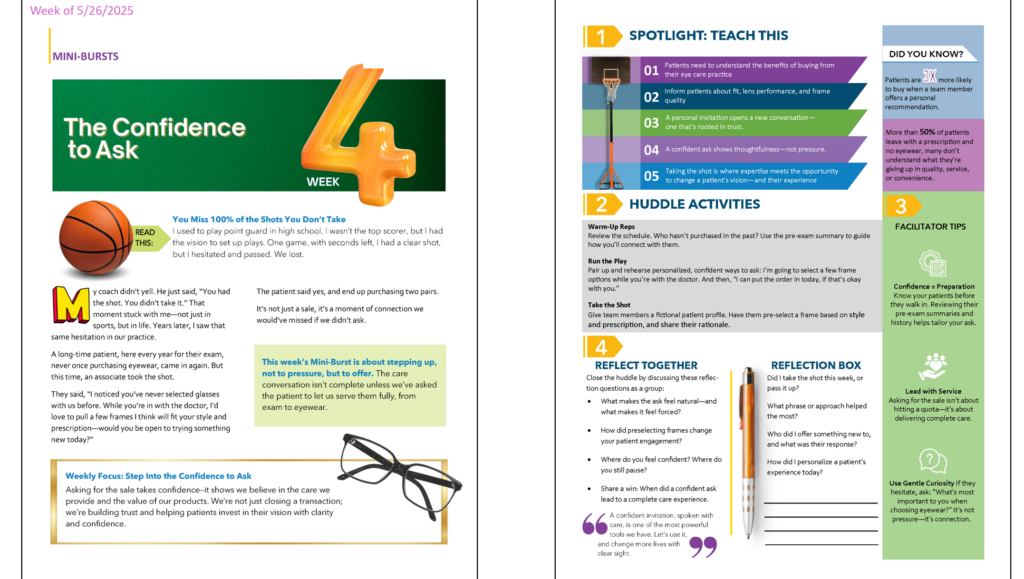
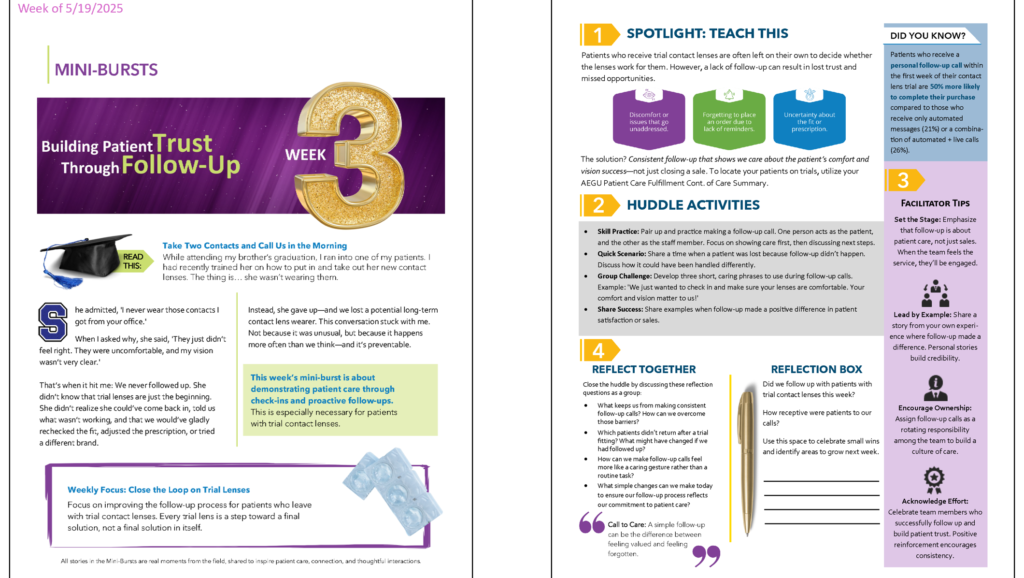
AEG Vision needed a scalable, low-lift learning solution to improve performance across a distributed workforce without disrupting daily operations. I designed and launched the Mini-Bursts microlearning strategy to deliver targeted, high-impact training that aligned directly to business priorities and revenue growth.
Business Challenge
Traditional training formats were time-intensive and difficult to deploy consistently across locations. Engagement dropped when training required long sessions, and critical performance behaviors were not being reinforced frequently enough to drive measurable change. Leadership needed a solution that:
- Fit into the flow of work
- Could be rapidly deployed and updated
- Produced measurable performance outcomes
Strategic Approach
I introduced a microlearning-first strategy centered on short, focused learning bursts designed to reinforce a single performance behavior or concept at a time. The strategy prioritized:
- Speed to deployment
- Repetition and reinforcement
- Alignment with active business initiatives
Each Mini-Burst was intentionally designed to be consumed in minutes while still supporting long-term behavior change.
Execution & Delivery
I led the end-to-end design and implementation of the Mini-Bursts program, including:
- Designing the instructional framework and content standards
- Developing and launching 12 Mini-Bursts over a 9-week period
- Partnering with stakeholders to identify high-impact topics tied to revenue and engagement
- Producing concise, engaging learning assets optimized for rapid consumption
- Managing iteration and rollout across the organization
The program was built to be repeatable and scalable, allowing new Mini-Bursts to be added with minimal operational lift.
Outcomes & Impact
The Mini-Bursts strategy drove measurable business results:
- Contributed to a 2–3 point increase in overall revenue, with each point valued at over $1 million
- Improved learner engagement by reducing time barriers to participation
- Enabled faster response to emerging performance needs
The success of the program validated microlearning as a core component of the organization’s learning ecosystem.
Leadership Takeaway
This project demonstrates my ability to translate business needs into scalable learning strategies that deliver measurable impact. By designing systems rather than one-off solutions, I help organizations build learning programs that support performance, adaptability, and growth.
Overcoming Patient Objections: Scenario-Based Learning


Executive Summary
This project focused on improving patient communication and conversion outcomes by equipping frontline staff with practical strategies to confidently address common patient objections. I designed a scenario-based learning experience that emphasized real-world application, consistency in messaging, and behavioral practice rather than passive knowledge transfer.
Business Challenge
Staff across multiple locations were encountering recurring patient objections related to cost, treatment hesitation, and trust, which directly impacted case acceptance and patient satisfaction. Existing training materials were informational but did not adequately prepare staff to respond confidently in live patient interactions.
Leadership needed a solution that:
- Improved real-time communication skills
- Increased confidence when handling objections
- Supported consistent patient experiences across locations
Strategic Approach
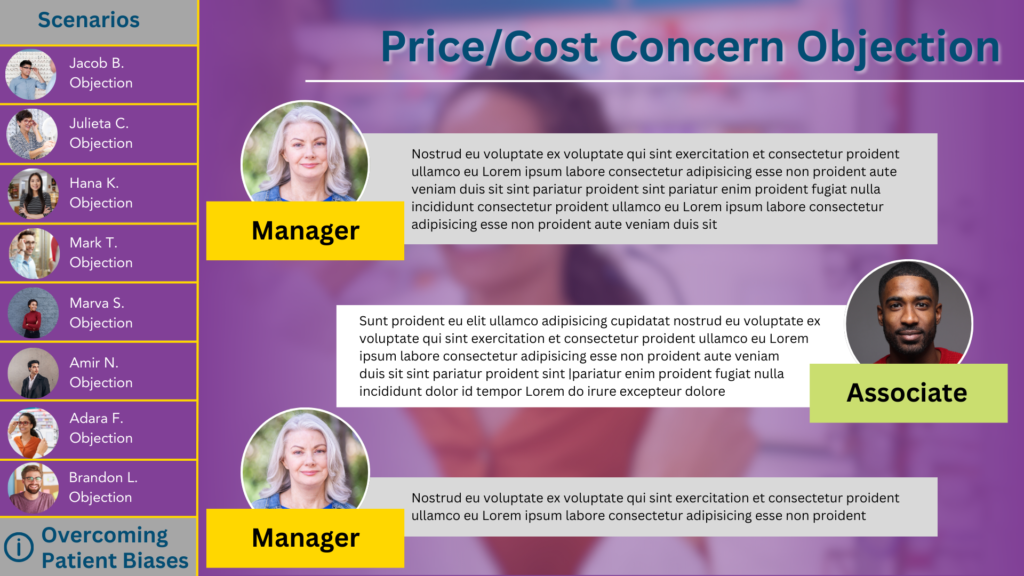
I designed a scenario-based learning strategy centered on realistic patient conversations. Rather than focusing solely on scripts, the training emphasized:
- Decision-making in context
- Empathy-driven communication
- Repetition and reinforcement of best practices
The approach allowed learners to practice responding to objections in a low-risk environment while reinforcing behaviors that align with organizational goals.
Execution & Delivery
I led the end-to-end development of the learning experience, including:
- Identifying the most common and high-impact patient objections through stakeholder input
- Writing realistic objection scenarios that mirrored real patient conversations
- Designing branching scenarios that allowed learners to evaluate response options and outcomes
- Developing feedback and coaching prompts to reinforce effective communication strategies
- Deploying the training in a format that was easy to access and integrate into existing workflows
The training was designed to be modular, allowing scenarios to be updated or expanded as new objection patterns emerged.
Outcomes & Impact
The scenario-based approach helped:
- Improve staff confidence in handling patient objections
- Reinforce consistent communication standards across locations
- Support stronger patient interactions by shifting training from theory to practice
By focusing on realistic application, the training addressed a critical performance gap that traditional content-heavy approaches had not resolved.
Leadership Takeaway
This project demonstrates my ability to design learning experiences that drive behavioral change by aligning training with real-world performance demands. By prioritizing practice, feedback, and scalability, I help organizations move beyond informational training toward learning solutions that meaningfully impact outcomes.
Project Manager Onboarding Guide


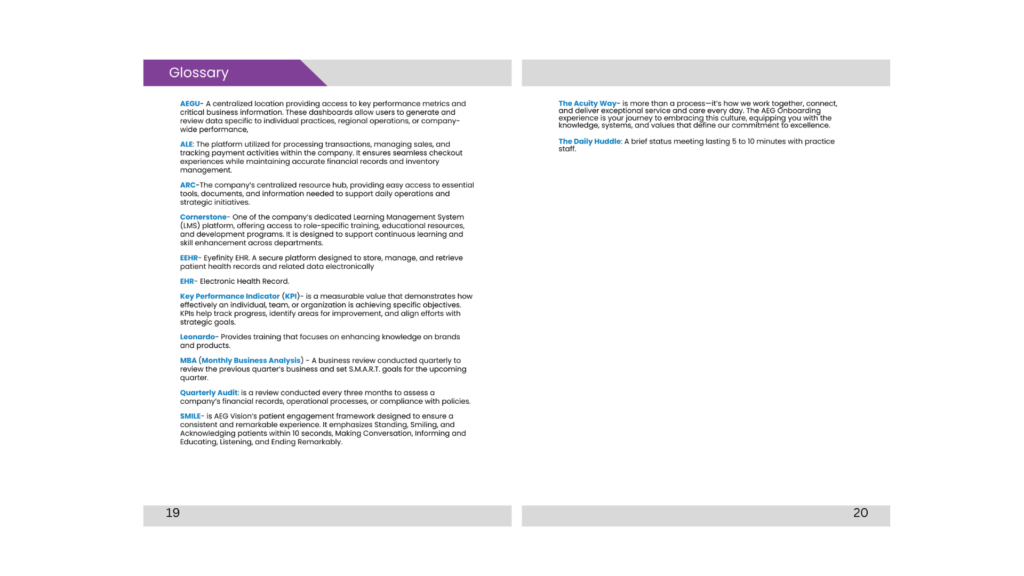
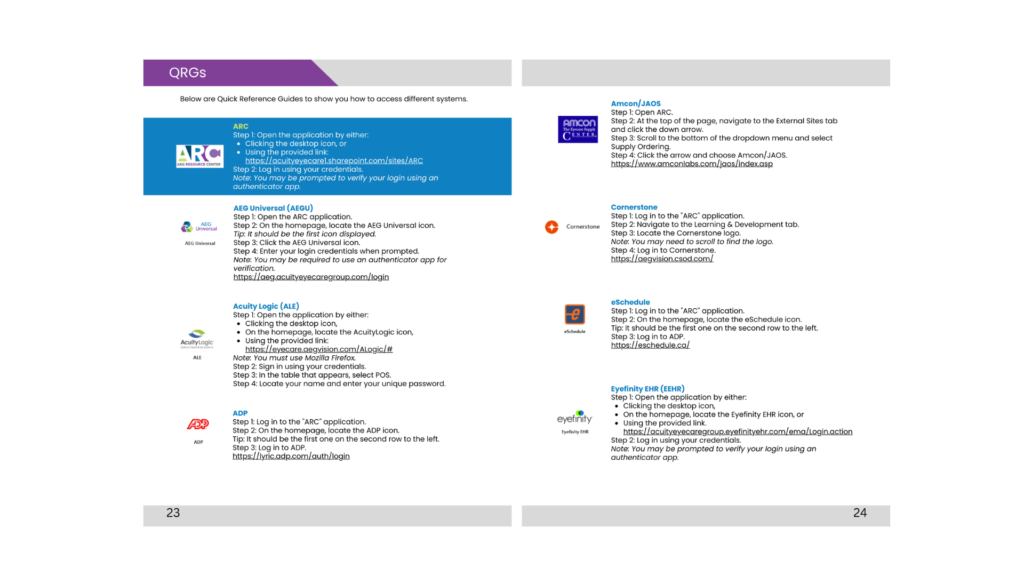
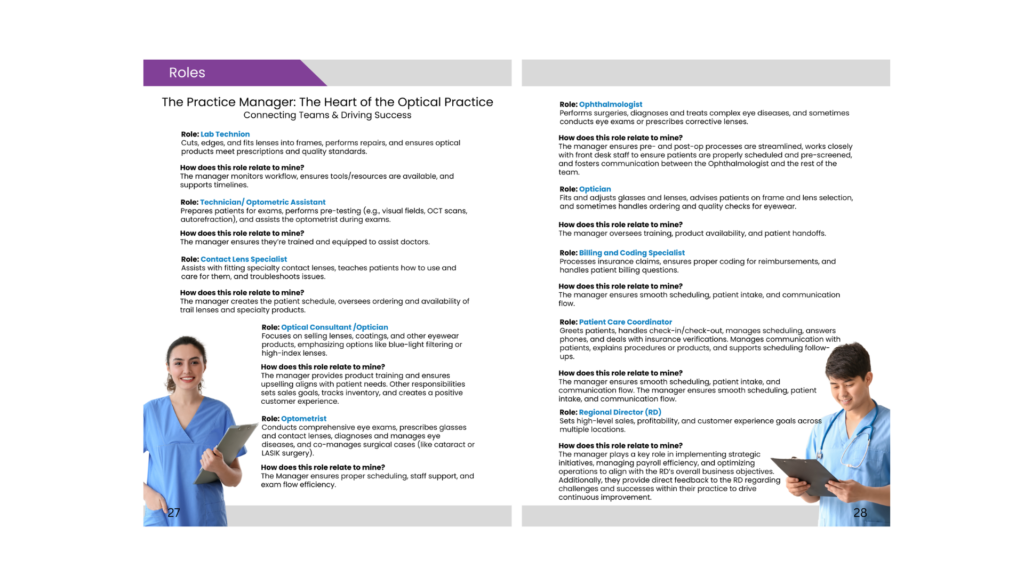
Executive Summary
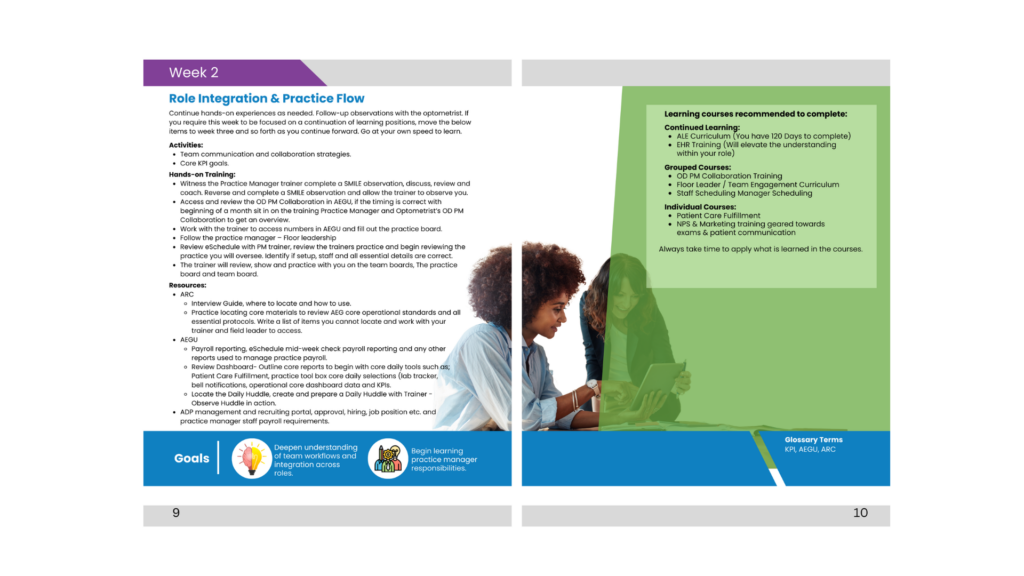
This project focused on improving time-to-productivity and role clarity for newly hired Project Managers by designing a structured onboarding guide aligned to real operational workflows. I created a centralized onboarding resource that balanced process clarity, practical tools, and expectations, enabling new hires to ramp up more efficiently and confidently.
Business Challenge
New Project Managers were onboarding into complex environments without a consistent or clearly defined onboarding experience. Information was fragmented across tools, documents, and informal knowledge sharing, which led to:
- Inconsistent onboarding experiences
- Longer ramp-up times
- Increased reliance on ad hoc support from peers and leadership
The organization needed a scalable onboarding solution that clarified responsibilities, reduced ambiguity, and supported faster integration into active projects.
Strategic Approach
I approached onboarding as a performance enablement system, not a checklist. The strategy focused on:
- Defining role expectations clearly and early
- Aligning onboarding content to real project workflows
- Reducing cognitive overload by sequencing information intentionally
The goal was to create an onboarding guide that supported both immediate orientation and ongoing reference as Project Managers grew into the role.
Execution & Delivery
I designed and developed the Project Manager Onboarding Guide by:
- Partnering with stakeholders to identify critical responsibilities, tools, and success indicators
- Mapping onboarding content to the project lifecycle and key decision points
- Creating a structured guide that included process overviews, timelines, resources, and practical next steps
- Organizing content to support self-paced learning while remaining easy to reference during live work
The guide was designed to be flexible and maintainable, allowing updates as processes or tools evolved.
Outcomes & Impact
The onboarding guide:
- Provided a consistent onboarding experience for new Project Managers
- Reduced dependency on informal knowledge transfer
- Supported faster confidence-building and role clarity
By centralizing onboarding knowledge, the organization improved both efficiency and the overall new-hire experience.
Leadership Takeaway
This project demonstrates my ability to design onboarding systems that bridge the gap between information and execution. By aligning onboarding to real workflows and performance expectations, I help organizations accelerate readiness while maintaining clarity and consistency at scale.
These case studies reflect my approach to designing learning systems that support performance, scalability, and business outcomes. I’m always open to opportunities where learning can drive meaningful impact.